Angela März und Larbi Bouskine
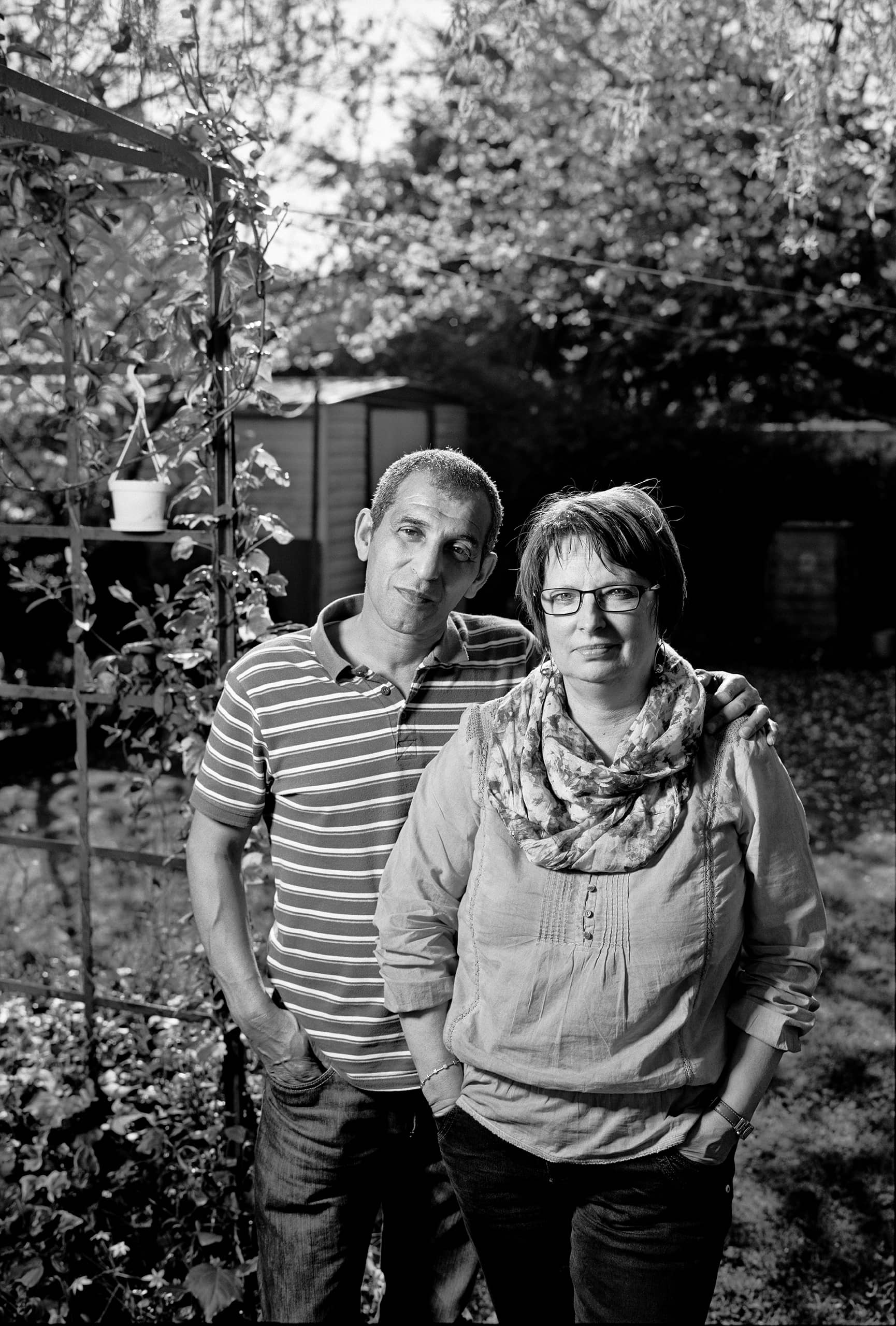
Angela März, 52, and Larbi Bouskine, 59, La Rochelle:
The bourgeois suburban idyll among the blossoming springtime trees would be perfect if not for the high-rise apartment blocks of the neighbouring Avenue Moscou that tower over the two-storey terraced houses in the small cul-de-sac Rue Antoine Watteau. Mind you, Angela and Larbi's private idyll is not what you would call bourgeois either. They have been together for almost 30 years, are unmarried and have two grown-up children. Angela comes from Cologne and Larbi has Algerian roots. Their daughter Lisa, 26, wonders what she really is: German, French or Algerian?
Angela and Larbi met on a university exchange in Paris, in 1986. Angela's father had visions of his daughter wearing a veil or of being abducted. Larbi's mother, an Algerian in the Parisian banlieue of Saint-Denis who had been unable to master the French language over the years, had no idea where Germany was. She told him, »I thought you would bring a French woman home, but a German?« Even Angela, an analytical social pedagogy student, did not really know how to handle the cultural mix.
On their first visit to Germany, when she wanted to serve Larbi a quintessentially German dish – bratwurst and red cabbage – her Cologne flatmate said, »But Angela, he's Muslim!« It had not even crossed her mind: »I've never thought of him as Algerian, only ever as French.« It turns out that the bratwurst wasn't a problem, but he didn't want any cabbage.
Angela did not think it would last – such a long distance, such different cultures. When they were still together after three years, she took the plunge. To save him the discrimination in Germany – «He would easily have been taken for a Turkish man there,« says Angela – she moved to the Parisian suburb of Saint-Denis to be with him. Where Larbi feels at home, where he was born, where his mother speaks Kabyle, a Berber language. She calls it an Algerian enclave.
At this point, Larbi was Algerian, but when he was born, before Algeria had gained independence in 1963, he was French. Algeria belonged to France, so Larbi had French citizenship. When Algeria became independent, he lost French citizenship. In 1988 he applied for it again, which is officially known as »reintegration«. Although he had already been working as a social worker for the French civil service for years, he was supposed to take a test to prove that he could read and write French. In the end, though, he didn't have to do it.
Christmas 1993, which Angela's parents from Cologne were invited to celebrate with her Algerian in-laws in the Parisian suburbs, was when the two families and cultures finally became truly united. »My father was more the type for a contemplative Christmas and I thought, 'Oh God, it's going to be such a culture shock!'« Angela remembers. »But it was great, my parents really got to experience a large family, 20 people at a massive table. We ate couscous. And alcohol was allowed, too. My father was so impressed.«
Since then, the household has acquired a number of citizenships. As well as her German nationality, Angela also has French. »I didn’t want to lose my German citizenship, and since 2002 we've been able to have both.« Similarly, Larbi wanted to keep his Algerian passport after his French »reintegration«. I finally ask Larbi what nationality he ultimately feels he is. »Je suis un terrien« – an earthling, he answers with a laugh. Then he gets up to fetch us another beer as we sit on the patio under the blossoming trees, surrounded by the high-rise apartments of Avenue Moscou.